-
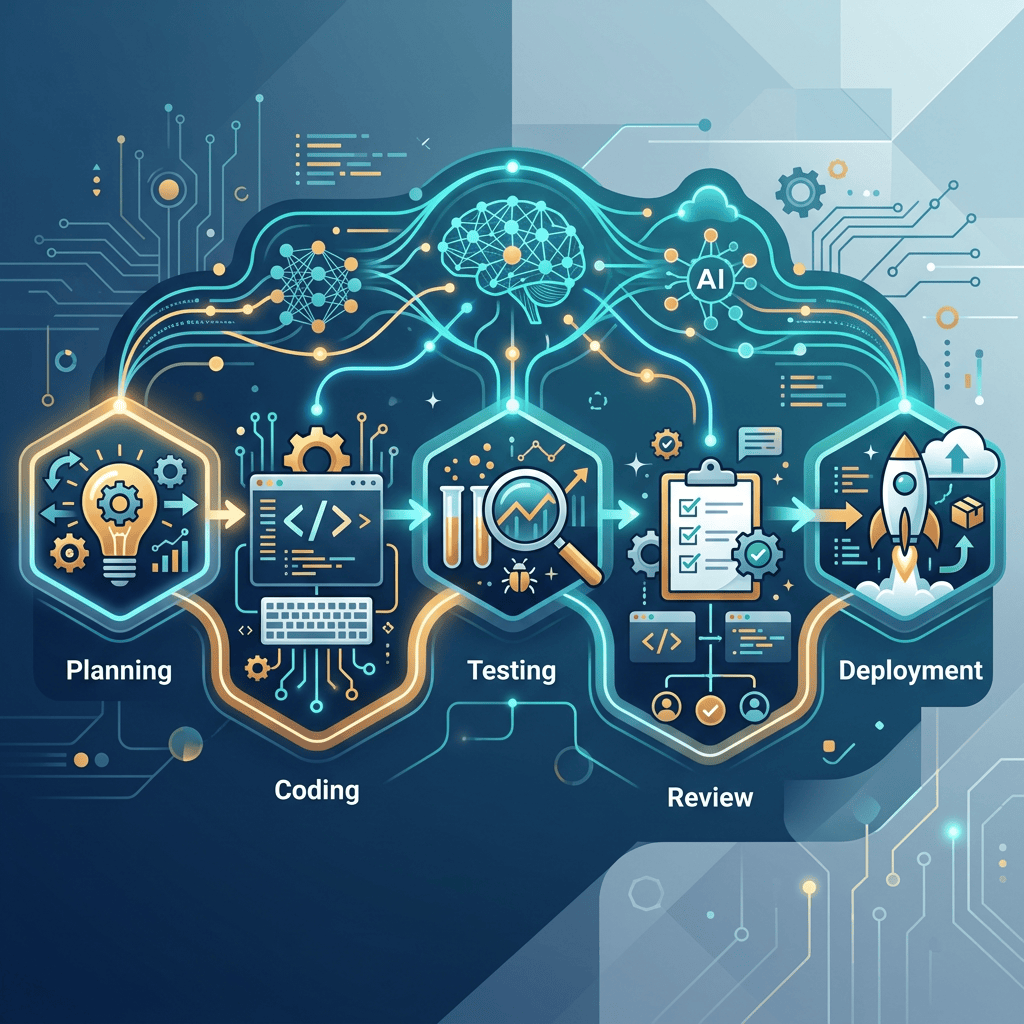 Continue reading →: Getting Started with the AI SDLC Workflow Harness Manager: Configure Your Coding Agent for Structured Software Delivery
A practical guide for AI strategists, solution architects, and engineering teams who want to move beyond AI-assisted coding and introduce repeatable AI-driven software development workflows. In my previous article introducing the AI SDLC Workflow Harness Manager, I discussed an important shift taking place in software engineering: organizations are moving from…
-
 Continue reading →: The AI Tsunami: Navigating the Next Wave of Innovation and Disruption from an Indian Vantage Point
Introduction: The Roar from Delhi This week, the AI Summit in Delhi brought together a potent mix of senior leaders—from the bustling heart of India’s IT sector to the nuanced world of news agencies and the critical realm of talent acquisition. The discussions weren’t just about the promise of Artificial…
-
 Continue reading →: 🌐The Next AI Frontier: From Assistants to Autonomous Agents — What Businesses Must Know
Artificial Intelligence is evolving faster than most organizations can adapt. We’ve watched chatbots become co-pilots, generative models reshape workflows, and now an entirely new layer is emerging — autonomous AI agents capable of acting, interacting, and even networked communication independent of humans. Two phenomena at the epicenter of this shift…
-
 Continue reading →: Small Language Models (SLMs): The Enterprise Architect’s End-to-End Guide for 2025 and Beyond
Summary The rapid evolution of Generative AI has made Large Language Models (LLMs) accessible to businesses of all sizes. However, as enterprise teams move toward production-ready AI systems, they face recurring challenges: high cost, latency, privacy concerns, unpredictable behavior, scaling overhead, and environmental impact.This has resulted in a major industry…
-
 Continue reading →: AI-Assisted Development for Architects: Comparing GitHub Copilot vs Cursor
For solution architects and technical leads evaluating how to embed AI-assisted coding into enterprise software development lifecycles, understanding the strengths, limitations, and fit-for-purpose of AI tools is critical. In this article I’ll compare GitHub Copilot and Cursor across multiple axes — functionalities, real‐world enterprise‐use scenarios, integration, governance, security, and architecture-level…
-
 Continue reading →: Reinforcement Learning: Unlocking the Next Frontier in LLM Business and GenAI Applications
1. Introduction – Why Reinforcement Learning Matters in the Age of LLMs Large Language Models (LLMs) are reshaping the digital and enterprise landscape by enabling natural interaction, task automation, and decision support across industries. From customer service chatbots to code generation platforms, businesses are rapidly embedding GenAI into their ecosystems.…
-
 Continue reading →: Scaling for Millions: Building Digital Architectures that Grow with Your Business
Every business today dreams of reaching millions of users. But the question that keeps CIOs, CTOs, and business leaders awake at night is simple: 👉 “Will our technology survive when success arrives?” Scaling isn’t just about adding more servers or buying bigger machines. It’s about designing an architecture that grows…
-
 Continue reading →: Database Scaling: A CXO’s Guide to Powering Digital Transformation
Summary When organizations embark on digital transformation, they often focus on applications, cloud migration, or customer-facing experiences. Yet, the database layer—the system that stores and manages all business-critical data—quietly determines whether transformation efforts succeed or stall. A system that struggles with scaling can lead to slow apps, lost customers, regulatory…
-
 Continue reading →: What A2A and MCP Mean for Businesses: Building Future-Ready Agentic Enterprises
1. Executive Summary 🚀 Agentic AI, built on modern LLMs, is transitioning from one-off Generative AI pilots to autonomous, goal‑driven agents embedded in business operations. Model Context Protocol (MCP) enables agents to access corporate tools, data, and APIs securely and consistently—eliminating custom integration friction. Agent‑to‑Agent Protocol (A2A) allows agents to…
-
 Continue reading →: Understanding How Tools Like GitHub Copilot, Cursor, and WindSurf Use Agentic AI to Explore Codebases
The rise of LLMs (Large Language Models) and Agentic AI has dramatically transformed the way developers interact with source code. Tools such as GitHub Copilot, Cursor, and WindSurf are no longer limited to autocomplete—they now act as intelligent agents, capable of exploring, interpreting, and reasoning over complex codebases to assist…

Hello,
Welcome to Digi Wired
My cozy tech corner of the internet dedicated to all things that make you AI ready. Here, I invite you to join me on a journey of blogging, consultancy, and all things made in AI. Let’s get crafty!

